

Behind Norway’s 96% EV share
If you just skim the headlines, it looks like Norway woke up one morning and collectively decided to love EVs. In 2025, about 96% of all new cars sold there were fully electric, with some months pushing close to 98%. Tesla alone took nearly one in five sales with the Model Y becoming the single best‑selling car in the country. That sounds like mass moral enlightenment, but the real story is simpler and much less romantic (although entirely deliberate): Norway weaponized its tax code against internal‑combustion cars (ICE), especially powerful ones, and then quietly exempted EVs—Tesla included—from most of the damage.
A tiny market with absurd numbers (and a lot of Tesla's)
First, about Norway. Picture a country about the size of California, with the population of Minnesota, the overall sparsity of Montana, and a climate that mixes a soggy Pacific Northwest coast with upper‑Midwest winters.

That’s the lab where 96% of new cars are EVs yet in 2025 it registered close to 180,000 new passenger cars, a record for the country and almost 40% more than the year before. Around 96 out of every 100 of those new cars were electric, predominantly battery‑electric rather than plug‑in hybrids, and in some months BEVs were essentially the entire market. Tesla on its own accounted for about 34,000 of those cars, roughly 19% of all new registrations, and the Model Y alone grabbed around 27,600, or about 15% of the market.
That combination (small market, huge EV share, and one dominant EV model) turns Norway into a policy lab where you can see how buyers behave when you crank every tax lever to punish combustion and smooth the path for EVs. In a lot of countries Tesla is still fighting uphill against fuel prices, patchy charging and lukewarm incentives; in Norway, those external constraints are largely solved, and Tesla is what customers choose when the pocketbook, not the marketing brochure, is doing the talking. What makes this even more striking is that Norway’s climate should be hostile to EVs - cold winters, snow, and long dark days all hurt battery efficiency, yet EVs are treated as the normal default car, not a fair‑weather science project.
How Norway taxes cars: the hammer, not the nudge
Most countries have tried to push EV adoption with a light touch: a tax credit here, a purchase rebate there, maybe free parking or toll roads. Norway went in a very different direction; it didn’t just make EVs cheaper, it made combustion cars expensivefrom every angle, and because Tesla and other BEVs qualify for exemptions, they’re sitting right where the tax code points you:
1. VAT: 25% for ICE, partial exemption for EVs
Norway’s standard VAT (Sales Tax) is 25%, which is applied to petrol or diesel cars. For years, EVs, including Tesla's, paid zero VAT. Recently, Norway tightened this by introducing a cap so that EVs pay 0% VAT up to a certain price (for example, 500,000 NOK/$52.2k) and 25% only on the portion above that threshold. That still creates a massive price advantage for something like a Model Y Performance over an equivalent performance ICE sedan, because the Tesla only takes VAT on the slice of its price above the cap, while the ICE gets hit on the full amount.
2. One‑off registration tax: where performance ICE gets obliterated
On top of VAT, Norway levies a one‑time registration tax (engangsavgift) on new vehicles based on weight, CO₂ emissions, NOx emissions, and sometimes power; the more you emit and the more car you buy, the harder you get hit. Powerful petrol sedans and SUVs - think BMW M3, Audi RS, AMG models - are exactly the kind of car that racks up a huge registration bill, while EVs like the Model Y are exempt from the CO₂ component and only pay a relatively modest weight‑based fee. Analyses of Norway’s system show that it’s normal for a mid‑size ICE car to accumulate taxes equal to half or more of its pre‑tax value, and for a high‑CO₂ performance model the tax stack can easily run into the hundreds of thousands of kroner.
3. Fuel and usage: EVs win every day
Then there’s the day‑to‑day cost of actually using the car. Fuel taxes keep petrol and diesel prices high (at the time of writing, a US gallon of unleaded is would be around $8.50 in Norway). Electricity, mostly hydroelectric, is relatively cheap (about 20c per kWh) and low‑carbon. EVs also benefit from reduced or capped road tolls, cheaper ferries, discounted public parking, access to bus lanes in many areas, and favorable company‑car tax rules; taken together, this makes it far cheaper and more convenient to drive a Tesla every day than an ICE that already cost you far more up front. None of these perks are Tesla‑specific, but Tesla is one of the main brands reaping the rewards because it has a product in the sweet spot of price, practicality and range.
The Model Y vs the BMW M3: a tale of two invoices
Norway’s tax system really shows up when you compare a Tesla Model Y Performance with a BMW M3: different shapes, same “fast, desirable, premium” buyer. A 2025 Model Y Performance comes in around 500,000–550,000 NOK, while a 2025 BMW M3 is about 1,230,000 NOK, more than twice the price once Norway’s 25% VAT and CO₂‑based registration tax are baked in. Using a rough 10 NOK ≈ 1 USD, that’s roughly $55k versus $120k+ for cars that serve a similar itch in terms of performance and status.

For the Y, import duty is low or zero, VAT only applies above the EV cap, and registration tax is modest and mostly about weight; for the M3, import duty, full‑value VAT and steep CO₂/NOx registration charges all stack on top of each other. In round numbers, the Tesla is carrying the equivalent of a few thousand dollars in tax, while the M3 is dragging around the price of a second car just in taxes, and that’s before fuel. In a cold country where EVs lose some winter range, most Norwegians still see the Model Y’s trade‑offs as minor annoyances compared to the financial insanity of paying twice as much up front and more to run a thirsty ICE.
EVs in a cold climate: why Norway didn’t get the memo
On paper, Norway should be one of theworst places for EV adoption. As we all know, sub‑zero temperatures hit battery efficiency, reduce range, and slow charging; people need heaters, winter tires, and vehicles that can handle snow and ice. Yet Norway is where EV adoption is furthest along, and Tesla’s Model Y—hardly a small, hyper‑optimized city car—is the country’s best‑selling vehicle.
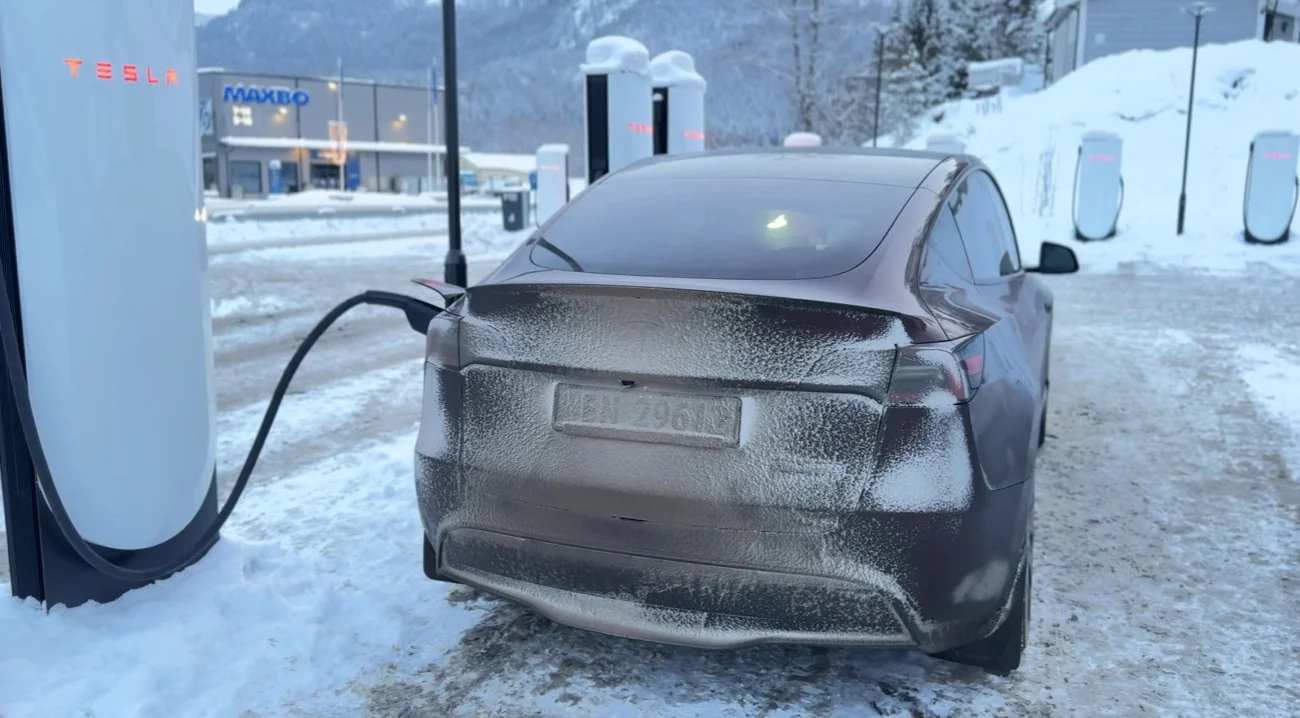
Norwegian drivers are well aware of winter range penalties and don’t romanticize them, but they’ve learned a few things in practice: range loss is predictable, home charging is convenient, and modern EVs from Tesla and others handle snow just fine with proper tires. From their perspective, the pain of occasional winter charging inconveniences is outweighed by the benefits. In that context, images of Model Ys happily charging in snow at a Supercharger station have become a kind of unofficial PR for the idea that “EVs just work here".
Do Norwegians “love EVs”? Or do they just hate paying tax?
None of this is to say Norwegians don’t care about climate; they absolutely do, and that helps sustain aggressive policies. But if you watch behavior, the signal is clear: once EVs became the better value proposition, adoption didn’t just rise, it exploded, and brands like Tesla that matched Norway’s practical needs took a disproportionate slice of the pie.
The EV share in Norway is high because:
-
The tax system aggressively punishes tailpipe emissions at purchase and over the life of the car.
-
EVs avoid many of those penalties and given daily‑life perks on top.
-
Tesla and a handful of others offer compelling, winter‑capable EVs in the right segments, so there’s no real sacrifice in everyday usability.
-
Cold‑weather drawbacks for batteries are seen as manageable nuisances, not fundamental flaws, given the total economic picture.
In that environment, wanting an ICE performance car in Norway is functionally the same thing as wanting to pay a massive tax bill. Most people, unsurprisingly, don’t. They buy EVs, often Teslas, not because they’ve fallen in love with electrons, but because Norway’s tax code has made everything else look irrational.